
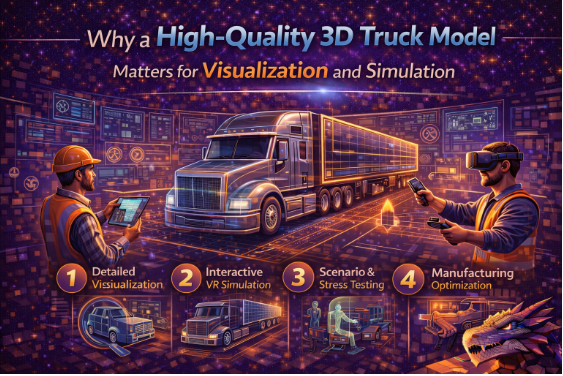

The more industrial and automotive projects in the industry turn digital, the less optional visualization and simulation tools are, and the more essential they are for design verification, planning, and decision-making.
Whether in terms of selecting or testing performance, training operators, or simply showing the vehicle to others, the quality of the digital object affects the result. This makes the quality of a 3D truck model essential.
Not all models are equal in value. Simple visualization models can appear satisfactory as graphics, but they can be inadequate as technical visualization and simulation. The better models will be designed with accuracy, organization, and efficiency in mind, and they will be reliable in different uses.
Authentic Representation Fuels Trust and Understanding
Clarity is the main goal of visualization. Where ratios, elements, and/or geography are called into question, models can be deceptive rather than informative.
A good 3D model of a truck captures the following:
- Car dimensions and scale
- Body, cabin, and cargo correlations
- Important functional elements
This accuracy allows engineers, plant operators, and decision-makers to share a common understanding of events. This leads to faster and more certain decisions when stakeholders believe their observations.
Visualization Is Only As Good As the Model Behind It
Visualization can also be used to describe complex trucks to audiences who are not familiar with them. Sales personnel, customers, investors, and trainees are some of those who use visualization to comprehend truck design and functionality.
Low-quality models will normally:
- Over-Simplify Components
- Removed structural restrictions
- False presentation of accessibility or mobility
In contrast, a good model enables believable walkthroughs, exploded views, and explanations at the detail level. This adds significantly to the explanation and understanding of the design, functionality, and value, and this will apply to complex vehicles like industrial ones.
Accuracy in Simulation is Dependent on the Accuracy of the Model
It brings in a new level of rigor over what can be achieved by visualization. In order for simulations to produce results worth interpreting, it is necessary to ensure the model’s technical quality.
A good truck quality simulates by incorporating:
- Correct geometry for collision and clearance calculations
- Component placement for system interaction
- Scale standardization for load, balance, and movement evaluation
Inadequate representation of these parameters in simulation can generate questionable simulation results, which can, in turn, be an origin of flawed assumptions, costly errors, or unsafe operation choices.
Promotion of Training and Readiness for Operations
Trucks that are intended for use in an industrial or construction setting may require training that is a bit more specific than that of a typical truck simulation training module. This is important since individuals may need to know how a truck handles before they can use one on a construction site.
High-quality 3D models allow for:
- Operator training simulators
- Maintenance and repair walkthroughs
- Safety procedure visualization
- Training for emergency scenarios
Since the model is a replica of the actual car, trainees develop familiarity that can be directly applied to the actual car.
Facilitating Cross-Functional Collaboration
One of the largest benefits that comes from having such an efficient 3D truck model is that it is capable of meeting the needs of several teams simultaneously. As opposed to dealing with different resources for designing, marketing, and training, a professional truck model can be shared across different sectors of the business.
It facilitates the following:
- Engineering reviews
- Manufacturing planning
- Marketing Visuals
- Simulation and testing
- Training content
With the same digital core, misalignments occur less, and the collaboration process is enhanced. There is continuity of intent from design through delivery.
The Value of Optimization Relative to Detail
It is not high-quality if it is unnecessarily heavy or inefficient. The best ones find the optimal balance between detail and performance.
For simulation and graphical purposes, models must have:
- Designed for real-time rendering
- Designed for easy updating and modification
- Runs efficiently on varied computer platforms
Models that are improperly optimized can result in lag, crashing, or restrictions within simulation platforms. Well-constructed models are optimized to be user-friendly while maintaining realism.
Long-Term Value Beyond a Single Project
A high-quality model is not a result but a long-term digital asset. When cars change over time or new models are launched, a well-structured model can be extended rather than being recreated from scratch.
Such future-proofing enables an organization to:
- Update the model to accommodate different versions
- Update simulations based on changing requirements
- Extend the application into marketing or training
The return on investment increases over the years as the same model delivers results in different initiatives.
Why Professional Execution Makes All the Difference
For a model that can function perfectly as a visualization tool as well as a simulator, there is much more required beyond artistic ability.
It is for this reason that many organizations work with an expert 3D visualization company and are also appreciative of the art of storytelling as well as accuracy. So that the model works to a professional standard in all applications.
Conclusion
In the industrial and automotive business, simulation and visualization can only be considered effective if the digital assets supporting the process can also be considered effective. A good 3D truck model helps guarantee that exactly that happens: what is viewed, tested, and simulated is accurate.
Through enhanced visualization clarity, the accuracy of simulations, facilitated training and collaboration, and the potential for long-term use, the quality of a model has a direct effect on the success that a project achieves. A truck model that is created with exactness and focus not only serves a visual function but also aids the success of the entire project process when created with a specific goal and focus.